

A business turnaround is a planned recovery for a business that is viable underneath but losing money, short of cash or carrying debt it can't service. It usually runs in three stages over about 90 days: stop the cash bleeding, fix what is causing it, then rebuild on a footing that holds. Most turnarounds that fail don't fail on the plan. They fail because the owner waited until the options had gone.
Can your business be turned around?
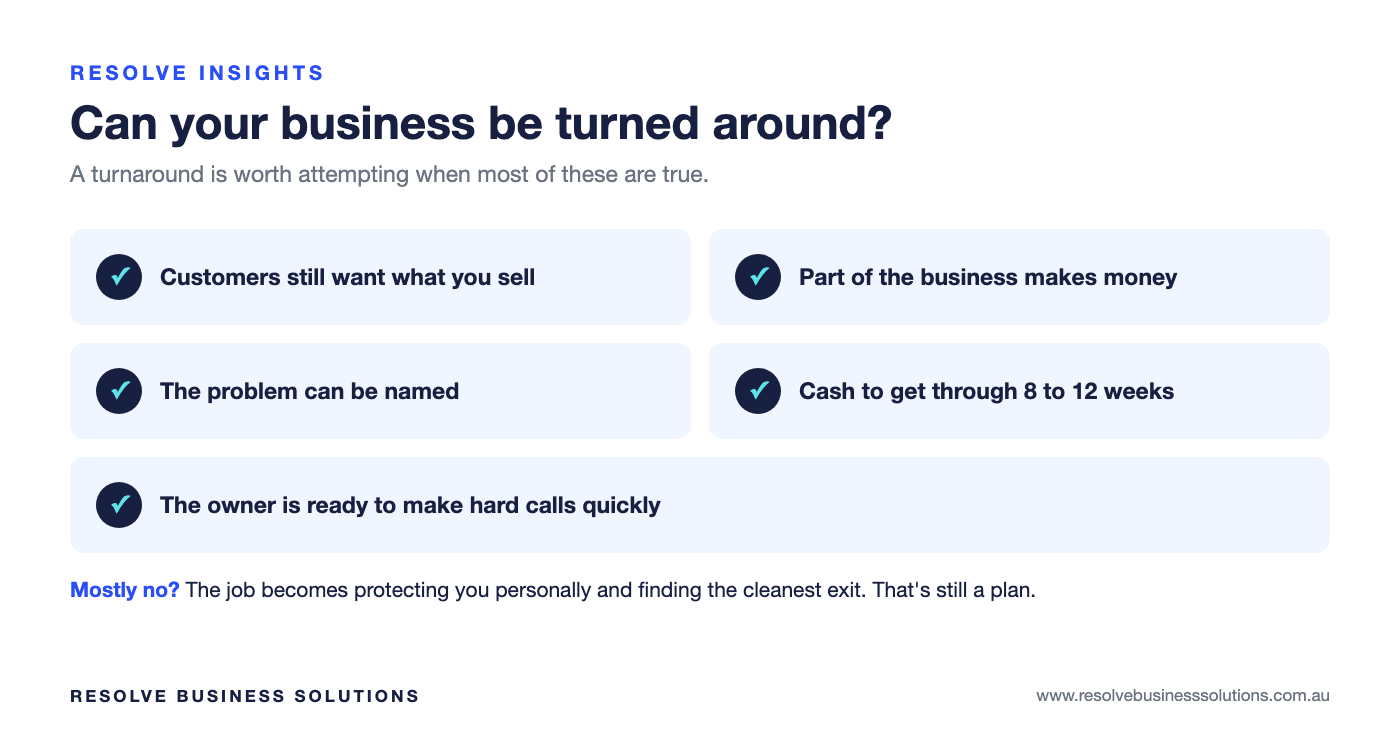
A turnaround is worth attempting when most of these are true:
- Customers still want what you sell.
- At least part of the business makes money, even if the whole doesn't.
- The problem can be named: pricing, costs, a bad contract, a cash cycle, debt, or the owner stretched too thin.
- There is enough cash, or access to it, to get through the next 8 to 12 weeks with changes made.
- The owner is ready to make hard calls quickly.
If the honest answer to most of those is no, a turnaround may only delay the inevitable. Then the job becomes protecting you personally and finding the cleanest exit. That is still a plan, and it is better made early.
The first 90 days, stage by stage
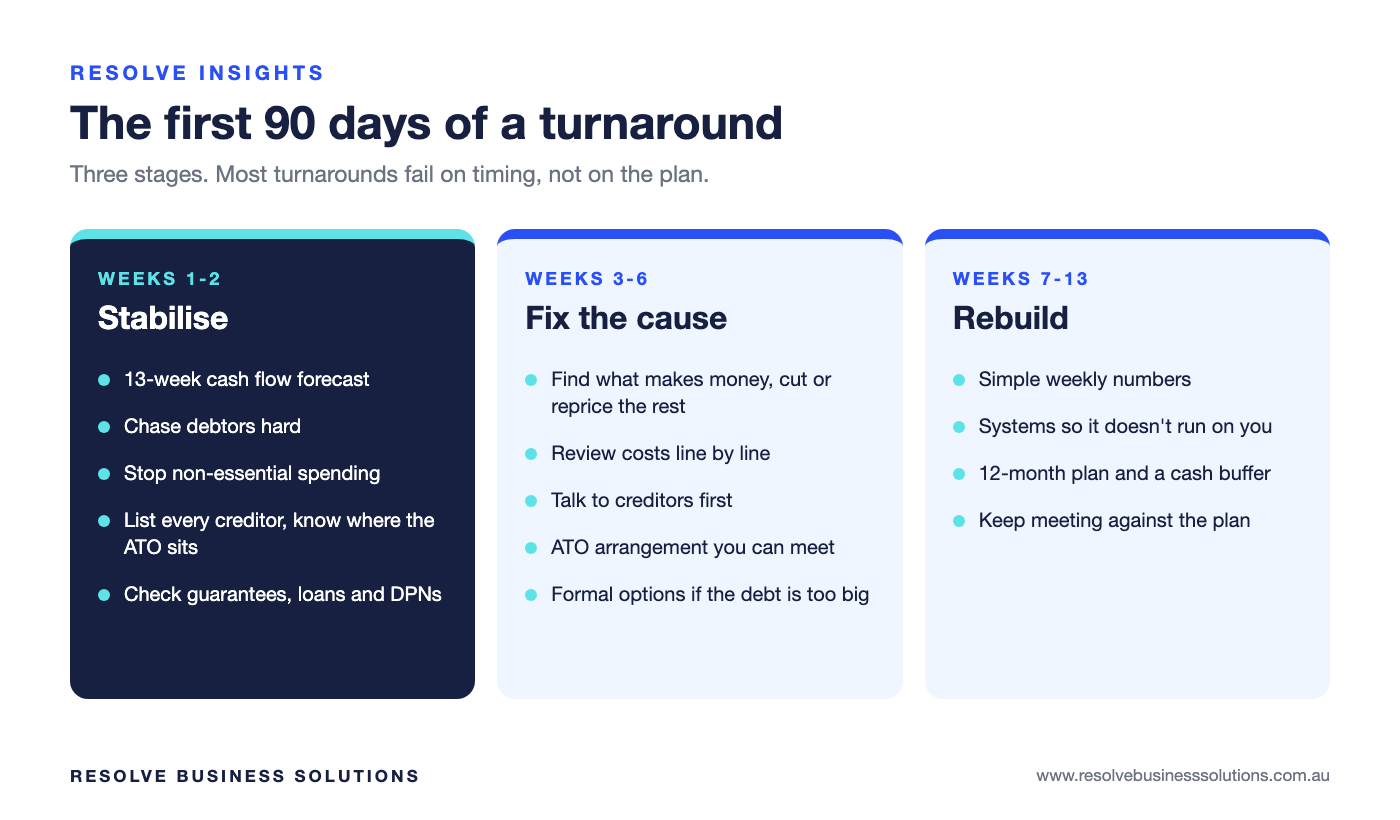
Weeks 1 to 2: stabilise
- Build a 13-week cash flow forecast so you can see the gap coming. Our cash flow forecast template is a starting point.
- Chase debtors hard. Cash owed to you is the cheapest money there is.
- Stop spending that doesn't keep the doors open or bring cash in.
- List every creditor, what is owed, and what is overdue. Know where the ATO sits.
- Check your personal exposure: guarantees, director loans and any Director Penalty Notice.
Weeks 3 to 6: fix the cause
- Find out which products, customers or jobs make money and which don't. Cut or reprice the ones that don't.
- Review costs line by line: rent, subscriptions, finance, staffing.
- Talk to creditors before they talk to you. A creditor who hears a credible plan early is far easier to deal with than one chasing an overdue account.
- Put an ATO payment arrangement in place that the business can actually meet, rather than one that sets you up to default.
- If the debt is too big to trade out of, look at formal options such as Small Business Restructuring, and get the right practitioner involved.
Weeks 7 to 13: rebuild
- Set simple weekly numbers: cash in the bank, sales, debtors, overdue creditors.
- Put systems in place so the business doesn't depend on you for every decision.
- Plan the next 12 months: pricing, the customers you want more of, and a cash buffer.
- Keep meeting against the plan. Turnarounds slip when the pressure eases and the old habits return.
What gets in the way
- Waiting for one more good month. It rarely fixes the cause, and every month of delay costs options.
- Borrowing to cover the gap. New debt to pay old debt buys weeks, not a fix. See borrowing to survive, or delaying the inevitable.
- Paying the loudest creditor. Not the most important one. The ATO and unpaid super usually carry the biggest personal risk for directors.
- Doing it alone. Owners under pressure make faster, better calls with someone outside the business checking the numbers with them.
Where we fit
We work with business owners through each stage: getting the real numbers, building the plan, dealing with creditors and the ATO, and coordinating your accountant, lenders and any restructuring practitioner so everyone works off the same page. We work for you, not your creditors.
I went through my own business collapse back in 1988, so I understand where you're sitting. In our experience there is almost always a way through, and it is easier to find early.
Questions we get asked
How long does a business turnaround take?
The stabilise and fix stages usually take about 90 days. Getting back to a business that is comfortably profitable with a cash buffer often takes 6 to 12 months.
What does a turnaround cost?
The first conversation with us has no charge. If there's work worth doing, we quote a fixed fee before we start, so you know the cost upfront.
Do I have to go into administration or liquidation?
No. Most turnarounds happen without any formal process. Formal options such as Small Business Restructuring are there if the debt is too large to trade out of, and we'll tell you straight if that's where things are heading.
What if the ATO is already chasing us?
Call us before you agree to anything. The terms you agree to now can make or break the turnaround, and a Director Penalty Notice has strict deadlines.
Talk to us
Call Resolve Business Solutions on 0499 099 009 or email support@resolve.net.au. No charge for the first conversation, no obligation.